Where Chinese lacquer stands
China has one of the longest lacquer traditions in the world. Lacquered objects have been found at Neolithic sites; lacquer work flourished from the Warring States period through the Han dynasty, and by the Ming and Qing dynasties it had grown into a very wide range of decorative methods.
Our database records 85 Chinese techniques, including regional variants, more than for any other cultural region in the database.
Key texts
- Xiushi lu (髹饰录, “Records of Lacquer Decoration”), written by Huang Cheng in the Ming dynasty and annotated by Yang Ming. It is the only surviving pre-modern Chinese book devoted entirely to lacquer; its second volume, in sixteen chapters, classifies the decorative techniques.
- Xiushi lu jieshuo (髹饰录解说), Wang Shixiang’s commentary, the standard modern study of the Xiushi lu.
- Xiushi lu jiaojian (髹饰录校笺), an annotated edition by Chang Bei.
- A history of Chinese lacquer art (中国漆艺美术史), by Shen Fuwen.
Representative techniques
| Technique | Group | Key features |
|---|---|---|
| Monochrome lacquer (suxiu, 素髹) | Coating | A single colour with no decoration; it shows the basic skill of applying lacquer evenly |
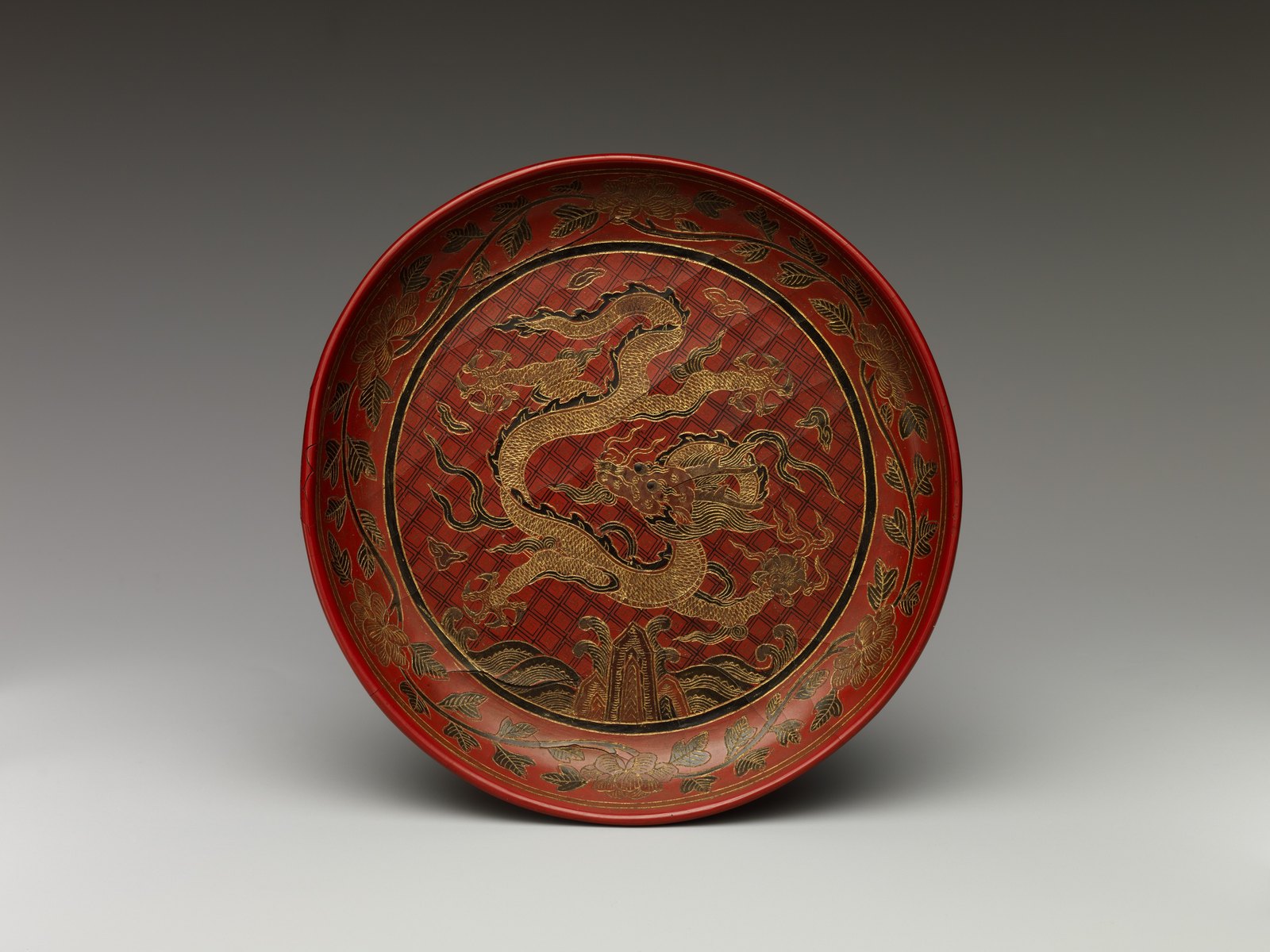
| Gold painting (miaojin, 描金) | Painting | Designs painted in gold powder, with fluid lines |
| Mother-of-pearl inlay (luodian, 螺钿) | Inlay | Thin pieces of shell set into the lacquer layers, giving an iridescent sheen |
| Fine shell inlay (dianluo, 点螺) | Inlay | Extremely thin shell cut into tiny pieces and strips, as fine as detailed brush painting |
| Eggshell inlay (蛋壳镶嵌) | Inlay | Fragments of eggshell set into lacquer, forming a crackle-like pattern |
| Incised gold (qiangjin, 戗金) | Incise and fill | Lines are incised into the lacquer surface and filled with gold, so they read as engraved; the Japanese counterpart is chinkin |
| Xipi (犀皮) | Mottled lacquer | Layers of different colours built up and then polished down, so the pattern flows naturally |
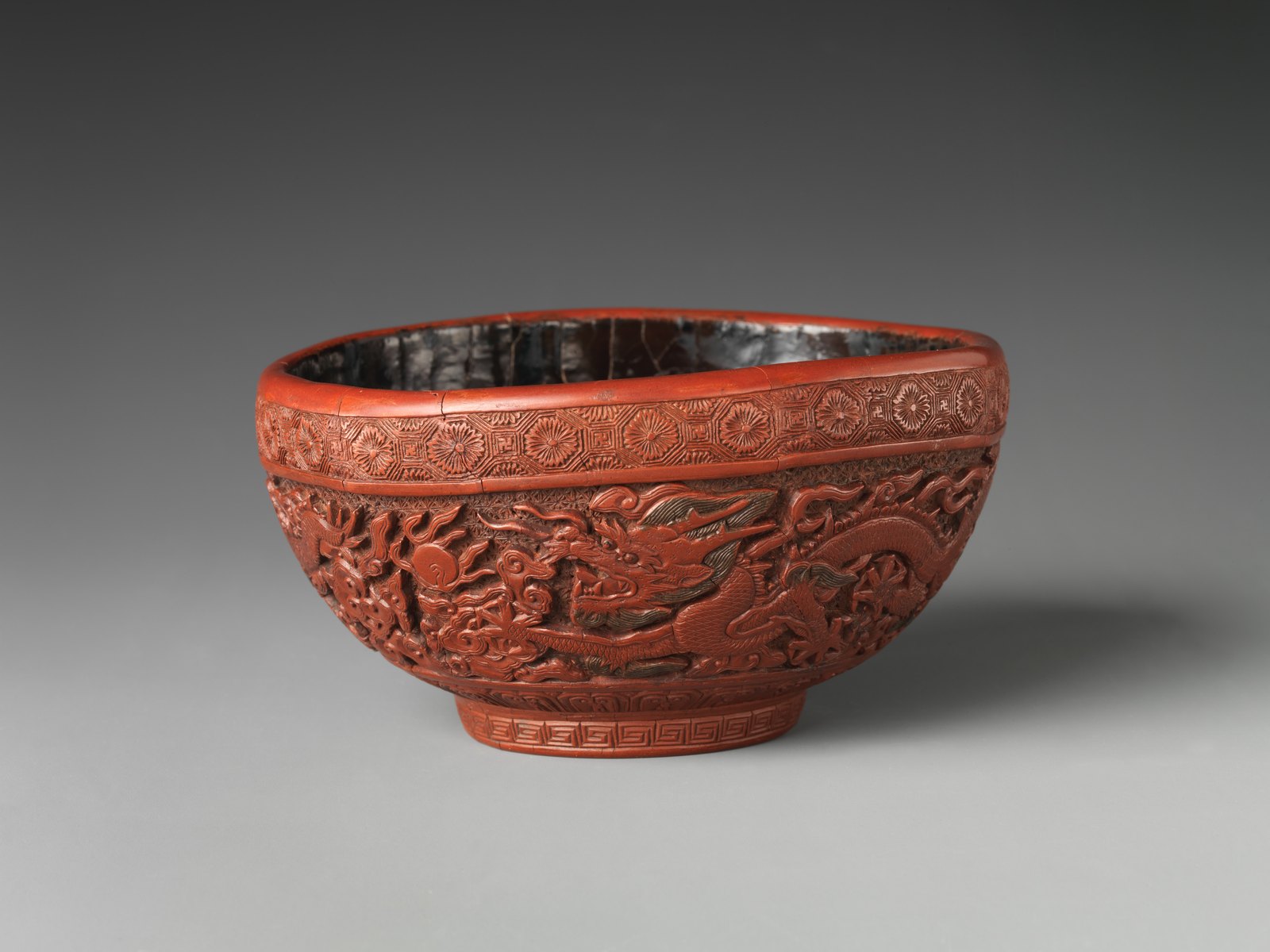
| Carved red lacquer (tihong, 剔红) | Carved lacquer | Many layers of red lacquer built up and then carved in relief |
| Carved layered lacquer (tixi, 剔犀) | Carved lacquer | Alternating black and red layers carved so the cut edges show the bands |
| Bodiless lacquer (tuotai, 脱胎漆器) | Body making | Hemp cloth laid up with lacquer over a mould; light and strong |
| Aluminium powder under clear lacquer, polished | Polished painting | A method first developed by Qiao Shiguang: aluminium powder, transparent lacquer, then polishing |
| Clear lacquer overcoat (zhaoqi, 罩漆) | Coating | Transparent lacquer laid over a surface to protect it and deepen what lies beneath |
| Lacquer painting (彩绘) | Painting | Lacquer used as the paint for pictorial work |
| Raised and painted lacquer (堆鼓彩绘) | Raised work | Lacquer built up into low relief, then painted |
| Crackle lines (duanwen, 断纹) | Mottled lacquer | Crack patterns in the surface, as seen on old guqin zithers |
| Gold and coloured lacquer in relief (泥金彩漆) | Raised work and painting | Raised modelling combined with gold painting, giving high relief |
| Red and green “gem sand” lacquer (赤宝砂 / 绿宝砂) | Mottled lacquer | Special variants of the mottled-lacquer methods |
Regional traditions
- Fuzhou: known for bodiless lacquer, and home of the lacquered all-leather trunk once made as part of a bride’s dowry (see Craft).
- Yangzhou: a centre of mother-of-pearl inlay in the Ming and Qing dynasties, known for fine dianluo work.
- Pingyao: a tradition of raised decoration finished with clear lacquer.
- Beijing: carved lacquer and carved red lacquer made for the court.
- Chengdu: a long history of lacquerware with its own local style.
What is still practised
- Still practised: basic techniques such as monochrome lacquer, gold painting, mother-of-pearl inlay, qiangjin and carved red lacquer continue to be passed on.
- Lost: the complete form of gold and silver sheet inlay (jinyin pingtuo, 金银平脱), and three “wrapped” techniques that covered a body in leather, silk gauze or paper (皮衣、罗衣、纸衣).
- Endangered: some composite decorative methods; of about 25 multi-colour mottled techniques (斒斓) recorded in the old texts, only about 10 are still practised today.
- Contemporary developments: the polished aluminium-powder method (Qiao Shiguang), colour-lacquer floating (Li Zhiqing) and a subtractive working method (Cheng Xiangjun).
Visual character
- Sheen: mostly high gloss (monochrome lacquer, gold painting, mother-of-pearl).
- Texture: mostly smooth; the mottled techniques give layered or rippled textures.
- Colour: single colours (monochrome lacquer), many colours with metals (mixed inlay, baibaoqian), or gradients (mottled lacquer).
Image sources
- The Metropolitan Museum of Art: Bowl with dragon (2015.500.1.44), Public Domain (CC0)
- The Metropolitan Museum of Art: Dish with dragon (2015.500.1.53), Public Domain (CC0)
Related: Japanese lacquer techniques · Korean lacquer techniques · Which lacquer techniques combine · Craft