How does a maki-e artist trained in Edo fit literary scenes, auspicious figures and seasonal plants onto objects of very different sizes? Nakayama Komin’s work runs from writing boxes that hold brush and ink to inro small enough to hang from a sash, and in each case the gold and silver decoration is tied to the way the object opens.
A pupil of Hara Yoyusai in Edo
According to the Minneapolis Institute of Art, Nakayama Komin came from Edo (present-day Tokyo) and was a pupil of Hara Yoyusai, whom the museum calls one of the finest lacquer artists of the early 19th century. The Metropolitan Museum of Art gives his dates as 1808–1870.
The same Minneapolis text names him, together with Shibata Zeshin and Shirayama Shosai, as one of three important lacquer artists of the late period in Japan. Our pages on Shibata Zeshin and Hara Yoyusai (Chinese) give context for his world.
The Tales of Ise in a writing box
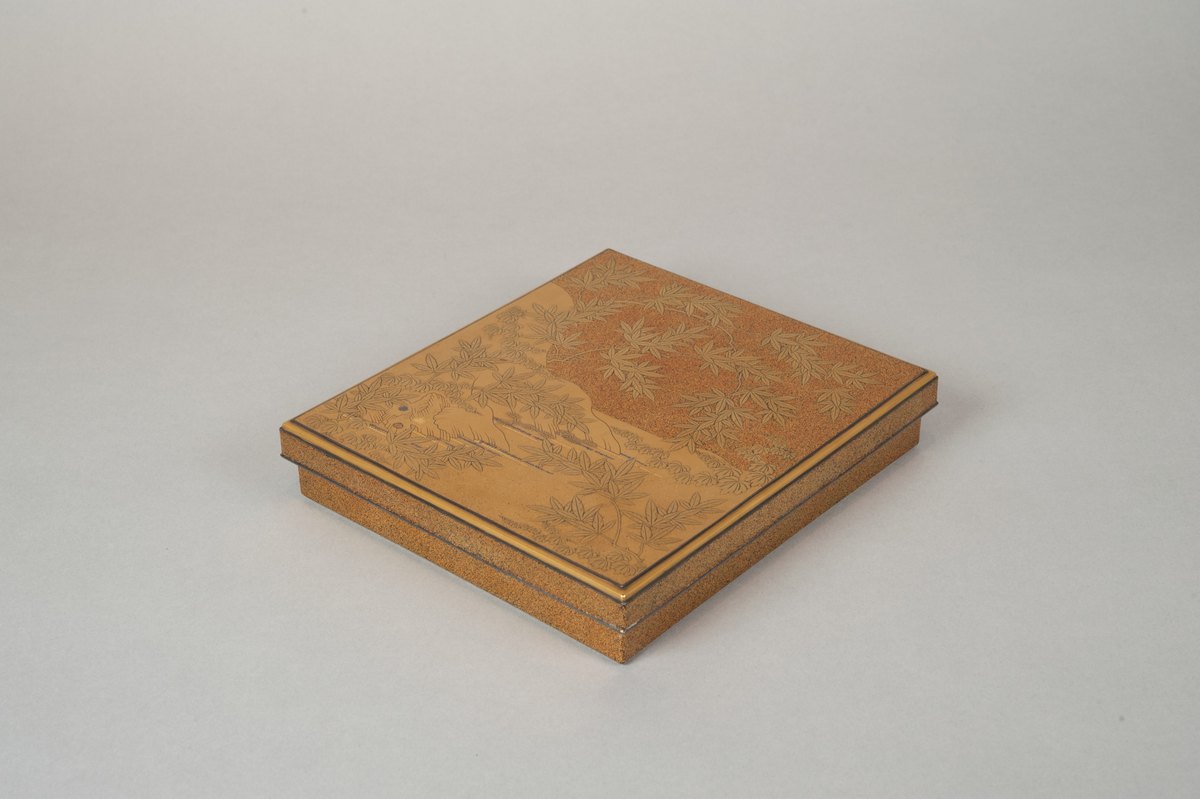
A writing box in the Met takes its subject from The Tales of Ise, a Heian-period literary classic. The museum records it as gold maki-e on lacquer with silver inlay. A writing box (suzuribako) holds the inkstone, water dropper and brushes, and the lid is the first thing its user sees.
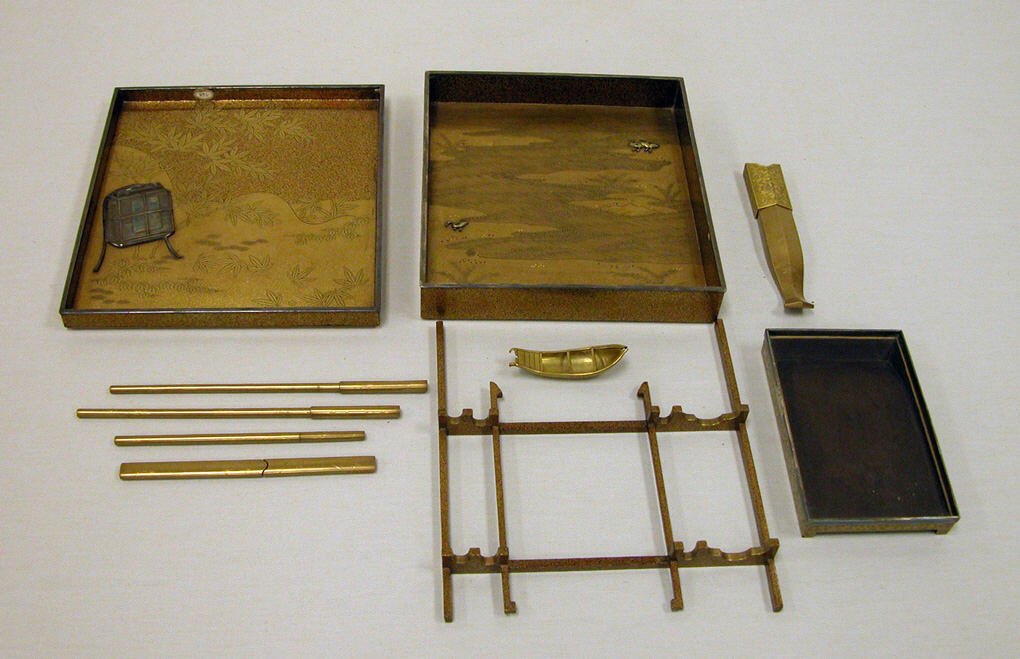
Another museum photograph lays out the lid, box, inner tray and fittings separately. Seen that way, the decoration is not confined to the lid: every part inside belongs to the whole writing set.
Figures and flowers on an inro
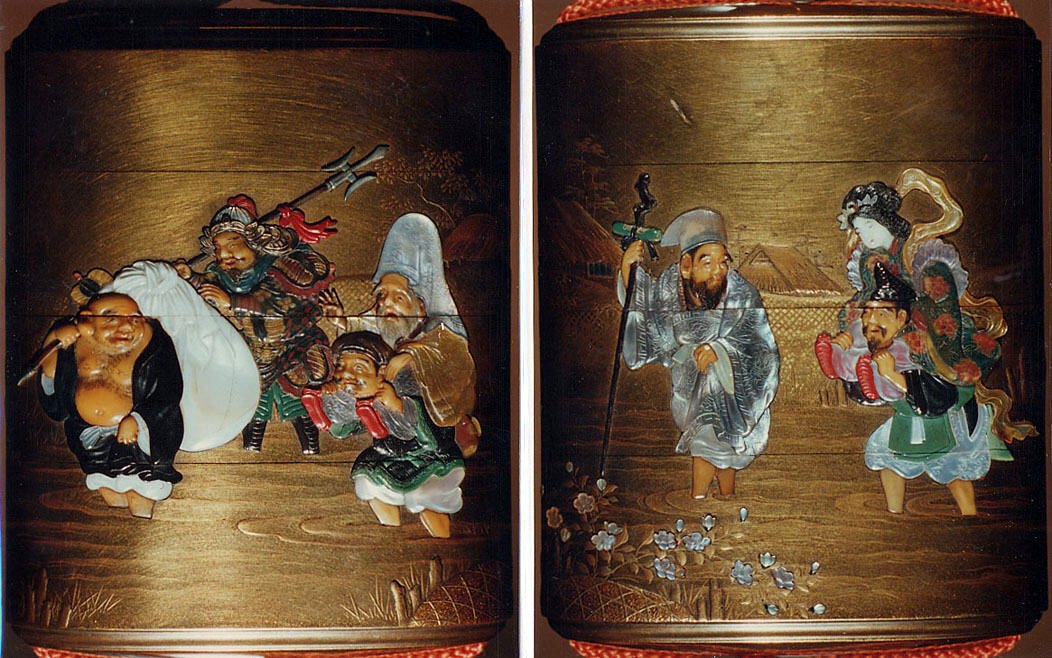
The Met holds two inro by Nakayama Komin. The Seven Gods of Good Fortune crossing a river inro is about 9.1 cm high. The museum records it as gold hiramaki-e on a gold lacquer ground, with the figures inlaid in shell, ivory and wood; the interior is nashiji and fundame. It comes with a netsuke set with an ivory bird-and-flower plaque and an ojime in the shape of Daikoku’s mallet. The figures are pieced together from several inlay materials.
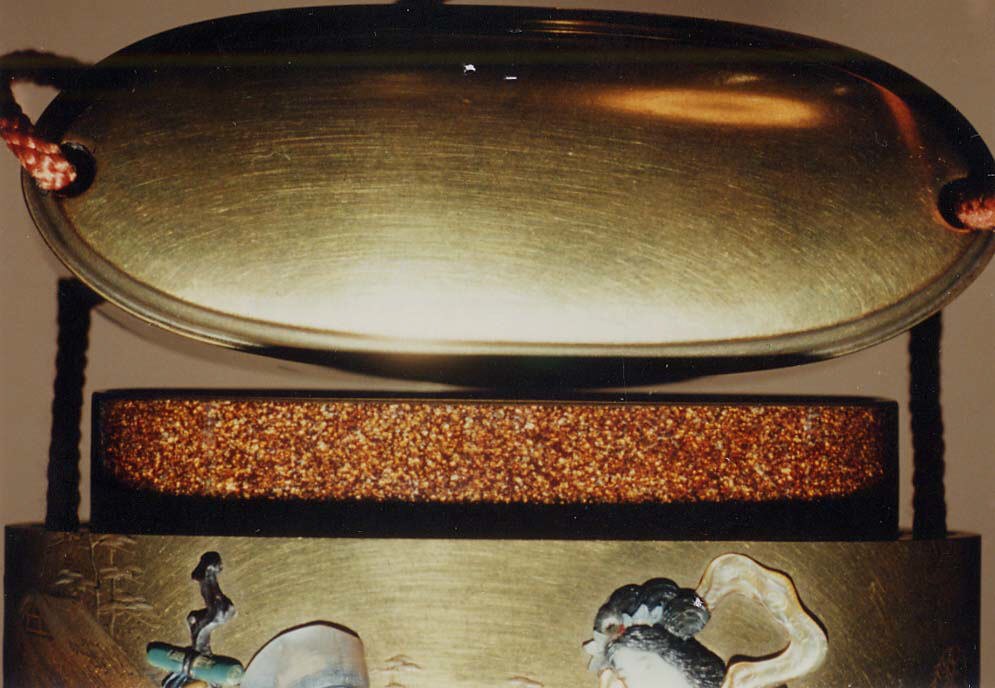
Open the inro and the inner walls between the compartments are finished as well; the museum’s detail photograph shows the stacked structure and the lacquered interior.
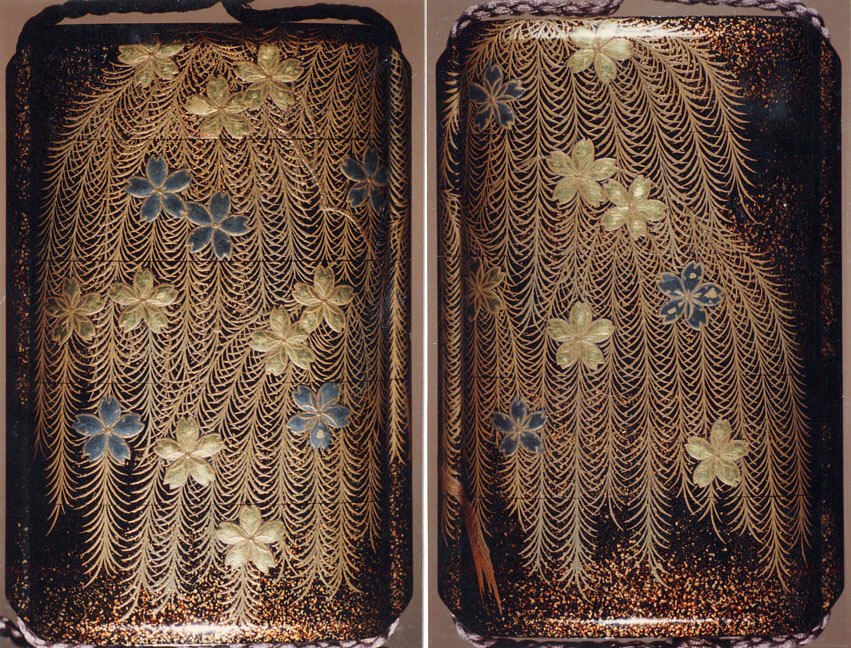
The second, an inro with willow and cherry blossoms, is about 7.8 cm high and is recorded as hiramaki-e and nashiji on black lacquer, with gold and silver foil. Fine willow strands hang from the top, with blossoms scattered between them; the fittings are an ivory ojime and a basket-shaped netsuke decorated with shell and gold lacquer. Where the Seven Gods inro builds its figures from inlay, this one works entirely in flat gold and silver lines and foil.
Late turn to ancient motifs
The Minneapolis Institute of Art notes that in later life Nakayama Komin took an interest in Japan’s ancient lacquerware and adopted many motifs he saw on 12th- and 13th-century pieces. A writing box from the 1860s in its collection is decorated with scattered lotus petals — a common motif on early Buddhist lacquer, which the museum explains as a symbol of the Buddha’s teaching. The box still has all its original fittings: inkstone, water dropper, two brushes, a small knife and an awl. There is no open image we can reproduce, so it is described here in text only; see the museum link below.
Three threads through his work
- A documented lineage. Museums list him as Hara Yoyusai’s pupil, placing his work within the Edo maki-e tradition.
- Subject follows the object. Writing boxes carry literary scenes; inro carry auspicious figures and seasonal plants.
- Materials shape the picture. The Seven Gods inro is built from inlay; the willow inro from flat maki-e and foil.