How can a cluster of irises and a zigzag bridge fill a folding screen and also serve as a way of composing a lacquer object? One way into Ogata Kōrin is to follow how his patterns cross from one medium to another. He reduced scenes from classical literature to a few strong forms, then let gold ground, ink line, mother-of-pearl and the lacquer surface each carry part of what the viewer sees.
1658–late 17th century: growing up in a textile house
The Metropolitan Museum of Art gives Kōrin’s dates as 1658–1716. He grew up in Kariganeya, a Kyoto textile house; his father, Ogata Sōken, supplied fine textiles to samurai and court clients. That household made him familiar with Noh, classical poetry and textile design, so materials, patterns and classical literature met in the same daily world from the start.
The National Museum of Asian Art (Smithsonian) notes that Kōrin turned to painting only in mid-life. He did not leave the pattern sense of his family’s trade on textiles; he carried it into paintings on paper, folding screens, ceramics and lacquer designs.
After 1704 – after 1709: a few forms organise the whole picture
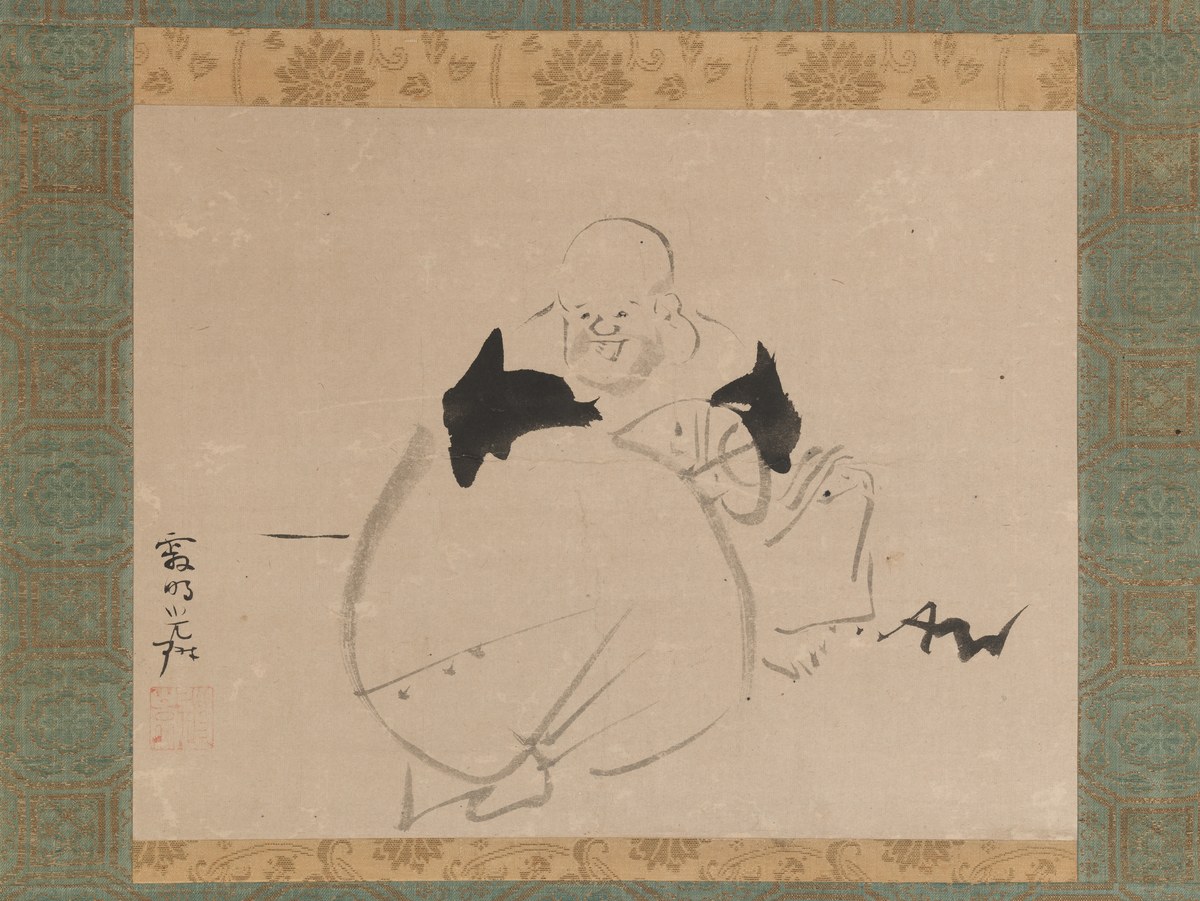
The Met dates Hotei to after 1704. The figure is built from a few economical ink lines and touches of ink wash; the curve of the body, the cloth bag and the large empty ground together set the pace of looking.
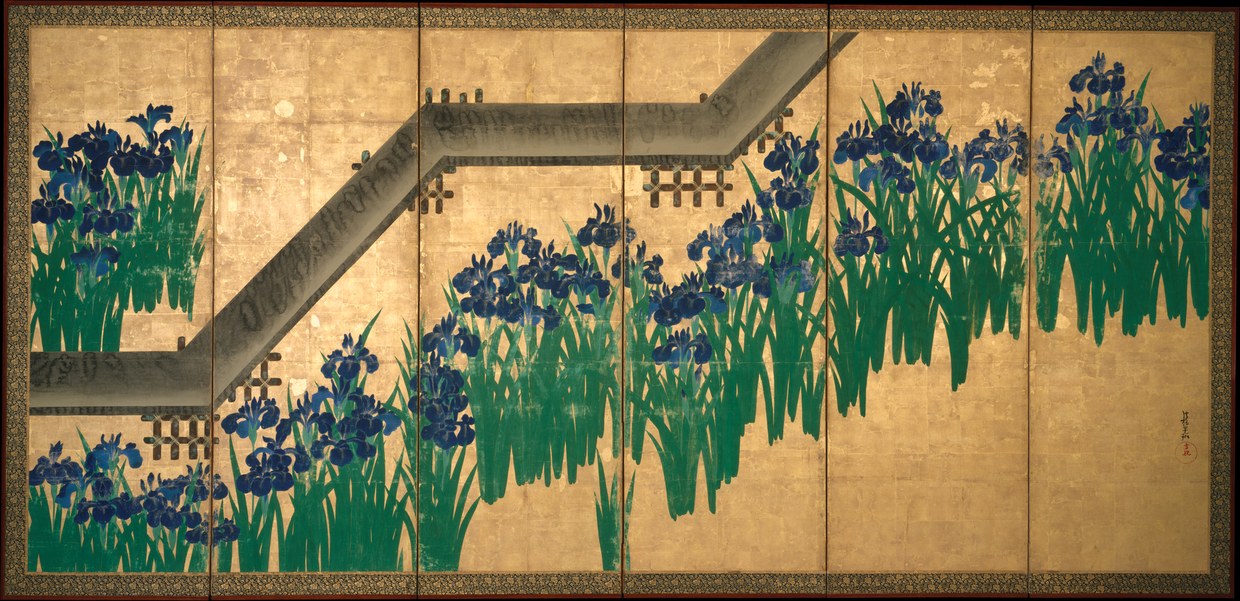
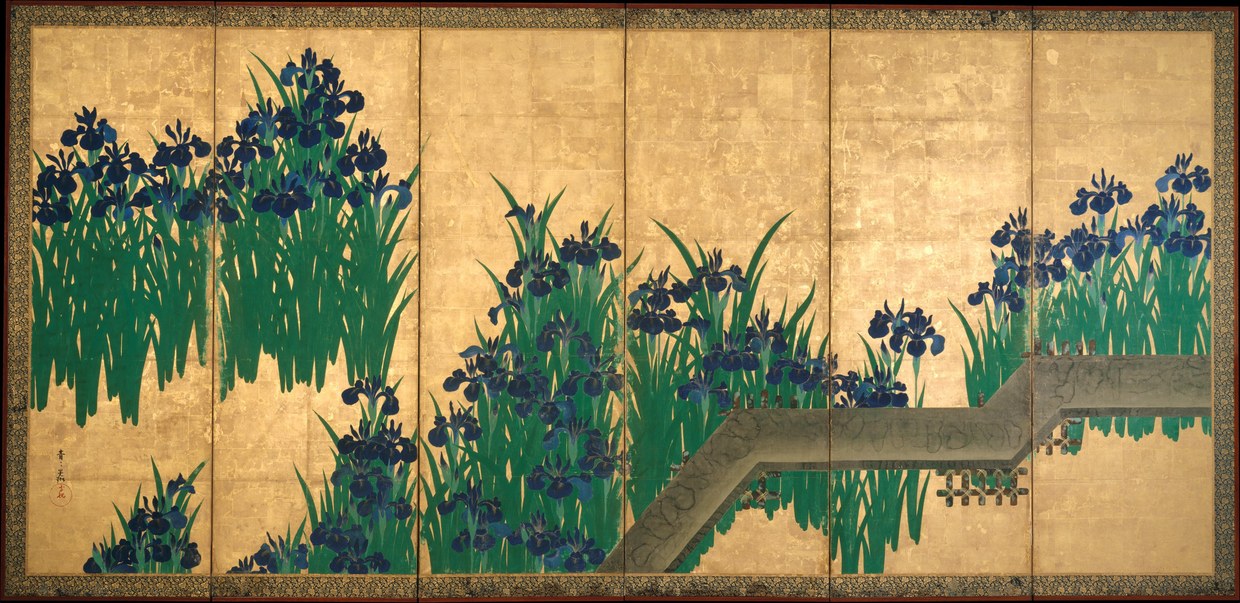
Irises at Yatsuhashi (Eight Bridges), dated after 1709, takes its subject from The Tales of Ise. Across the twelve panels of the pair of screens there are only irises, gold ground and a bridge running diagonally through the picture. The clumps of flowers build a rhythm through repetition, and the bridge links the two screens into one continuous movement.
18th century: pattern enters the lacquer surface and the object
The Met names Kōrin together with Hon’ami Kōetsu as designers associated with a new style of Edo-period lacquer, in which bold motifs, maki-e, mother-of-pearl and inlays of pewter or lead make strongly contrasting surfaces.
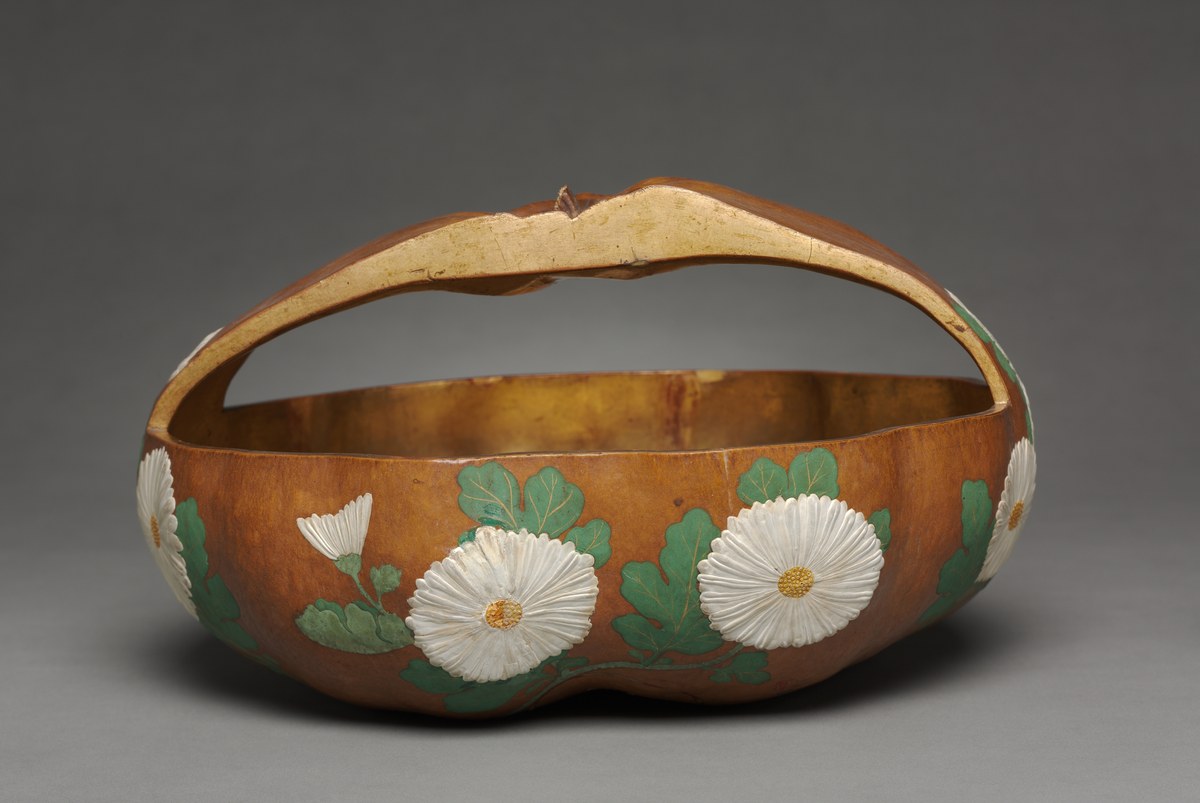
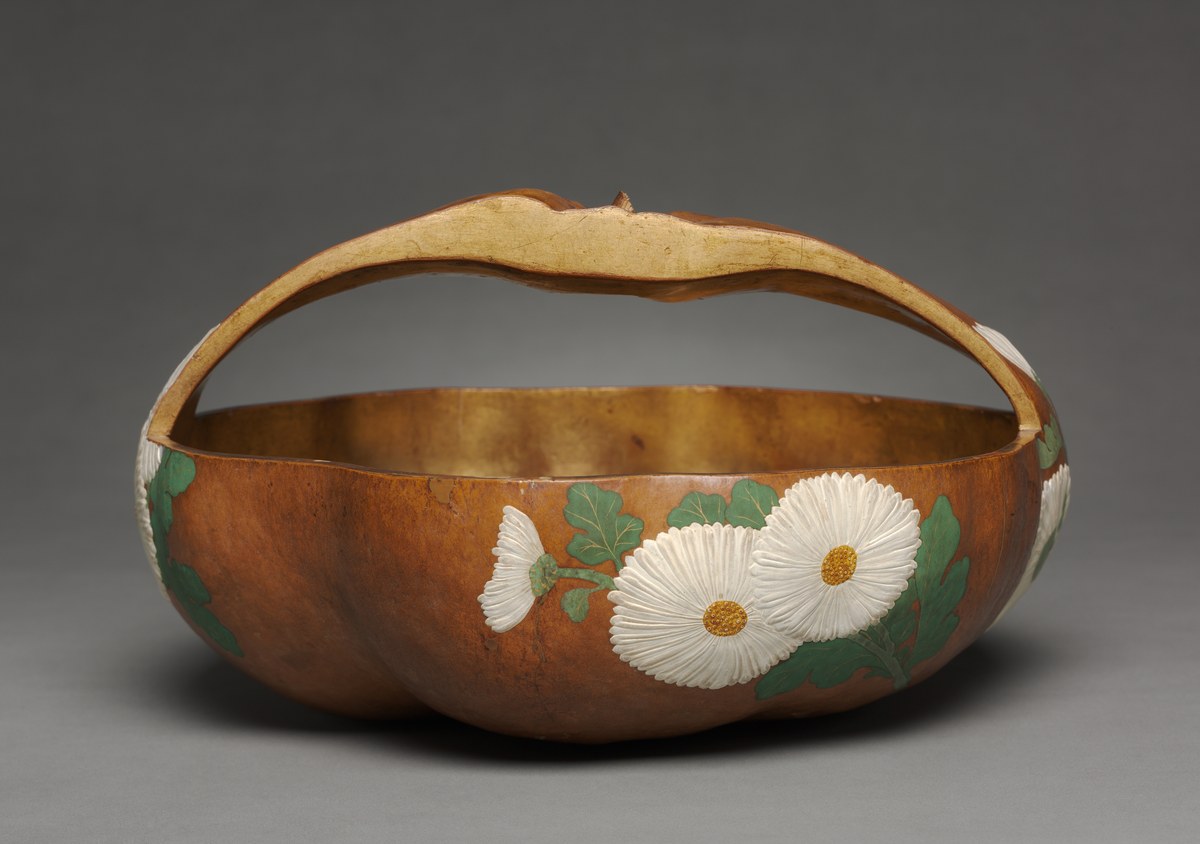
The Cleveland Museum of Art dates the gourd basket below to the 18th century and lists it as attributed to Ogata Kōrin. It is made from a carved gourd, lacquered, with chrysanthemums painted in gesso, colour and gold pigments. The flowers and leaves are not confined to a flat panel; they follow the handle and the curved body.
After 1716: a design language others could keep using
The Met notes that the name “Rinpa” comes from Kōrin, and that the work of Kōrin and his younger brother Ogata Kenzan spread through pattern books and manuals, influencing later craftspeople. The National Museum of Asian Art stresses that Rinpa was not an unbroken line of teachers and pupils but a group of artists who, in different periods, responded again to earlier compositions and ways of using materials.
So later lacquer pieces labelled “after Kōrin”, “in the Kōrin style” or “attributed to Kōrin” record more than a name: they record how a set of patterns left the original works and entered new workshops and objects.
Three threads through the work
- Classical literature turned into form: the Yatsuhashi screens do not illustrate the whole story; the direction of the bridge and the repeated irises let viewers recognise the scene from The Tales of Ise in a few shapes.
- Pattern not tied to one medium: visual habits from a textile house went into painting, ceramics and lacquer design, and the same sense of composition changed with paper, gold ground, lacquer and the shape of the object.
- Materials shape how we look: gold ground spreads light and ink line compresses form; on lacquer, mother-of-pearl, metal and raised petals make a surface that has to be read by moving the eyes and the body.
What Kōrin left is not only a set of recognisable motifs but a way of letting a pattern work again in a new material and form.
Sources
- The Met: Rinpa Painting Style
- The Met: Japanese Writing Boxes
- The Met: Hotei
- The Met: Irises at Yatsuhashi (Eight Bridges)
- The Cleveland Museum of Art: Gourd Basket with Chrysanthemum Design
- National Museum of Asian Art: Bold and Beautiful: Rinpa in Japanese Art
Image sources
- Ogata Kōrin, Hotei, after 1704. The Metropolitan Museum of Art, 2015.300.89. Public domain (CC0) under the Met Open Access policy.
- Ogata Kōrin, Irises at Yatsuhashi (Eight Bridges), after 1709, right- and left-hand screens. The Metropolitan Museum of Art, 53.7.1, .2. Public domain (CC0) under the Met Open Access policy.
- Attributed to Ogata Kōrin, Gourd Basket with Chrysanthemum Design, 1700s, two views. The Cleveland Museum of Art, 1963.101. CC0 under Cleveland Museum of Art Open Access.
More: Japanese lacquer artists · Shibata Zeshin · Shiomi Masanari · Nakayama Komin · Japanese lacquer techniques · Archive